Columbuses first voyage to the Americas centred on island hopping around the Caribbean. Whilst this sounds like an excellent holiday for most of us, when Columbus arrived he had a few ulterior motives in mind then relax on the beach and snap some photos. For one, the camera was a few years off invention (347 years to be more precise) but he was looking to claim lands for the Spanish Crown, see potential converts for Christianity and search for valuables such as gold and spices. Most importantly he was looking for another passage to India by travelling west. What he found however was not this. Instead was a network of islands, each with villages filled with Native peoples who had not seen a European before and in his accounts Columbus describes these people and the lands they inhabit.
In October of 1492 Columbus reached land in what he was convinced was the very far east of Asia. After claiming it for Ferdinand and Isabella, the King and Queen of Spain, he soon found himself greeted by the Natives that it inhabited. Columbus sort friendship, writing “I knew they were a people to be converted and won to our holy faith by love and friendship rather than by force.” He gave them gifts of glass beads and red caps which he stated “pleased them greatly”, and afterwards they swam out with items of their own to trade. Parrots, spears and balls of cotton thread among many were happily given up in exchange for “glass beads, hawks and bells.”[1] This would be the first of many encounters with the Indigenous people on his first voyage to what he would later discover wasn’t the reaches of Asia and a back gate to India but the Americas.
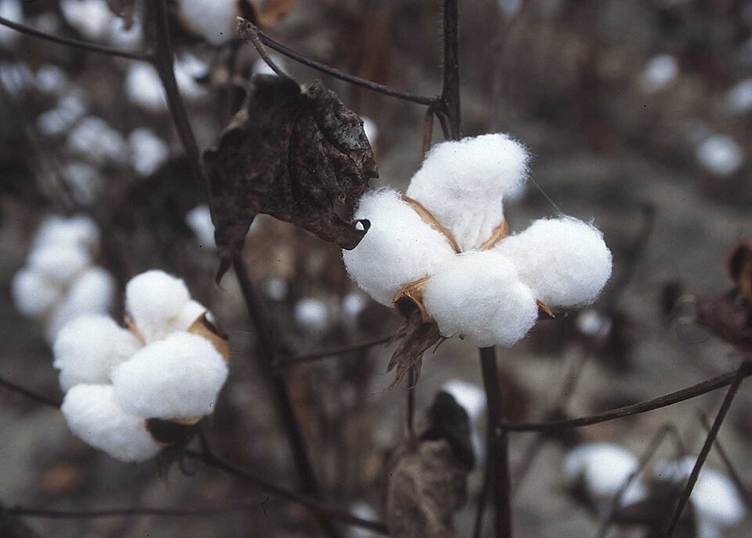
Cotton Bolls ready to Harvest
Now something about Columbuses accounts to remember is that he had not completed his main goal of finding another way to India for trade. It has been noted by many historians that he was somewhat under pressure to achieve this or to at least find something worthwhile for the Spanish Crown, who had financed his voyage. As John H Elliot points out a successful voyage might bring riches to an empty treasury. The crown was poor after heavy involvement in the Grenada war. Equally it would help initiate contact with nations in the east who would serve as both trading partners and potential Allies against their struggles with the Turks. Isabella had also thought of the possibility of laying the foundations for a great Christian mission.[2] But Columbus had not found India and thus needed to emphasis the important potential of his discovery. There was a sizeable motive for him to secure future voyages himself. He’d negotiated the governorship of any lands found and was to be made ruler of any regions discovered. Additionally he was to be given 10% of any valuables he came across. This meant when he came across the Americas he needed to make the most of what he discovered. Both to appease the Crown and to secure more voyages. Thus in his accounts it should be important to consider he wasn’t just writing down his experience but trying to sell these new lands to Ferdinand and Isabella. Equally another thing that needs to be mentioned, and is so by Reagan and Cruxent, is that most ethnographic information available are primarily about the Taínos and the Macorijes as Columbus interacted with them the most. As the Spanish are literate and the Indigenous aren’t, the vast majority of comments are from Spaniards about the Taínos. Thus the basis of understanding of Taíno-Spanish relations of things like trade is “severely compromised.”[3] What Columbus writes may be true but may also downplay or disregard how these interactions occurred.
Columbus talks about the Indigenous people in two main ways. He talks about trade with them and their physical descriptions. In terms of trade, he repeats all through his logbook how easy they were to trade with. In one notable example Columbus remarks “they will give all that they do possess for anything that is given to them, exchanging things for bits of broken crockery or broken glass cups.”[4] This should be noted is likely an attempt to highlight that they will trade for worthless items in Europeans eyes. They’d never seen glass before for instance so even a broken cup was highly valued in their minds. Columbus further backs this with evidence, by his own account he writes about seeing one Native give sixteen balls of cotton for three Portuguese cevtis.[5] A trade which was undoubtably in favour of the Spanish. what he is trying to do here is show how inept they are at trading for they do not understand the real or European value of these items traded. Antonello Gerbi sums this up, “the natives are so artless in bartering and so cowardly in battle that with the wiles of honest trading or the violence of arms, they can easily be persuaded to part with whatever one wants from them.”[6] it must be noted that Cotton was highly valued but upon the subject of how much cotton there is Columbus conveniently writes “if there were any quantity I would order it all to be taken for your majesties. It grows here on this island, but owing to shortage of time I can give no exact amount of it.”[7]
In terms of his descriptions of them he depicts them as rather less civilised than that of the European. In the opening account of his interactions with them he says, “But they seemed to me a people very short of everything. They all go naked as their mothers bore them, including the women, although I saw only one very young girl.”[8] Although this was fairly custom for the Taínos, to European standards this would seem indecent or maybe a touch anti-social to say the least. Columbus makes a few suggestions with what to do with them. On one hand he proposes a potential conversion to Christianity, something Isabella thought about. He writes “they have no religion and I think that they would be very quickly Christianized, for they have a very ready understanding.”[9] This was untrue however, the Taínos possessed many ritual items made of materials like wood, shell and bone.[10] He equally imposes that they could be subject to slavery. In his physical descriptions of them he portrays them as “fairly tall on the whole, with fine limbs and good proportions.” He describes how they are young, no more than thirty.[11] these are features desirable for a labour force. He praises their looks and physique which could be inferred as him selling the idea of using them as slaves to Ferdinand and Isabella. As he puts it himself “should your Highnesses command it all the inhabitants could be taken away to Castile or held as slaves on the island, for with fifty men we could subjugate them all and make them do whatever we wish.”[12] Throughout his logbook Columbus suggests how easy it would be to conquer the inhabitants of these new lands. He describes them as having “no belles”, suggesting they are poorly fed and malnourished.[13] In his first encounter he talks about how they did not know weapons, having showed them his sword they had cut themselves by taking it by the sharp end. The very next line he points out that “they have no iron.”[14] Altogether Columbus paints an image of how easy it would be to take control of the Islands he discovers and how easy it would be to exploit the local population. Both in trade by giving them useless items for those of value but also by turning the Indigenous peoples to slavery.
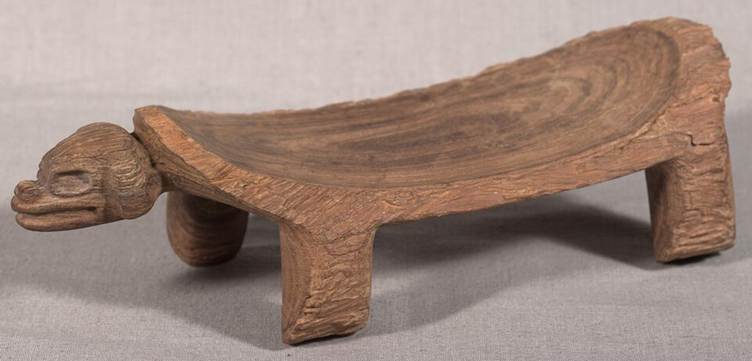
Duho, a ceremonial chair crafted by the Taínos
Columbus also describes in much detail the islands that he comes across. A frequent comment he makes on each island can be summed up by his words, “this island is Fairly large and very flat. It has very green trees and much water. It has a very large lake in the middle and no mountains and all is delightfully green.”[15] In his use of “green” and “flat” Columbus is likely selling the idea that this is fertile land which can easily be used to grow cotton among other crops. Yet another way of convincing the crown to fund another voyage out to the west. He talks about the Fauna and how different they are to that of Castiles. Another selling point of his is how he believes much of the new plants could be used for dyes or medicine that would fetch high prices in Spanish markets. He writes “I think that many trees and plants grow there which will be highly valued in Spain for dyes and medicinal spices. But I am sorry to say that I do not recognise them.”[16] It is clear by these descriptions that Columbus is suggesting how fit for profit this land is. Heike Paul recognises this, “Columbus has found, his letter seems to suggest, an earthly paradise, a place of beauty and abundance that he describes in superlative after superlative.” Paul writes how Columbus is trying to win the favour of the Crown, at least to secure funding for future voyages “an investment for the monarchs, he seems to suggest, with manifold and exorbitant returns.”[17]
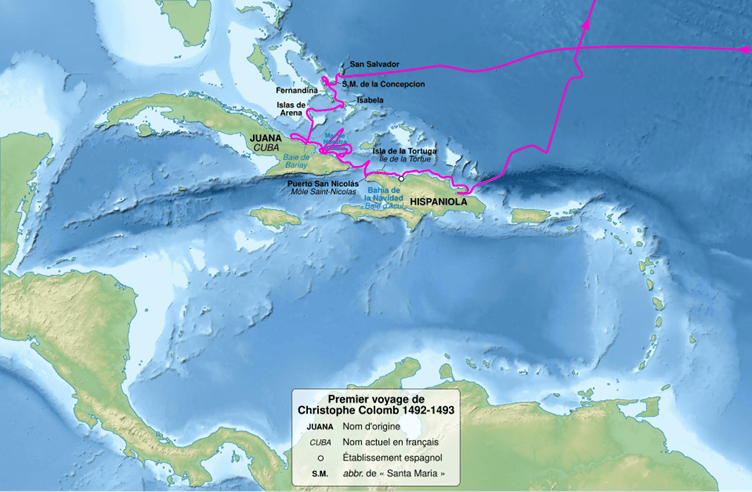
Map of Columbuses first voyage
Columbuses descriptions therefore are significant in a number of ways. Not only do they act as the first interactions between the Indigenous peoples of America but in his writing he portrays this new land as fit for the taking. The inhabitants are friendly and defenceless, trading anything they can for trivial items like red caps and glass beads. Columbus comments how easy it would be to convert or capture them. The land is fertile and flat, it would be no hard task to cultivate it to grow plants such as cotton which are sort after in European markets. With all this in mind it must be put forward that his accounts lay the groundwork and in some places foreshadow the future conquest of these lands.
[1] J. M., Cohen, (John Michael), The Four voyages of Christopher Columbus : being his own log-book, letters and dispatches with connecting narrative drawn from the Life of the Admiral by his son Hernando Colon and other contemporary historians (Penguin: London, 2004), p.55
[2] J. H., Elliot, (John Huxtable), Imperial Spain, 1468-1716 (Penguin: London, 2002), p.37
[3] Kathleen, Deagan and José María, Cruxent, Columbus’s Outpost among the Taínos: Spain and America at La Isabela, 1493-1498 (Yale University Press: 2002), pp.26-7
[4] Cohen, Four Voyages of Christopher Columbus, p.57
[5] Cohen, Four Voyages of Christopher Columbus, p.57
[6] Antonello, Gerbi, Author, (Jeremy Moyle), translator, Nature in the New World : from Christopher Columbus to Gonzalo Fernandez de Oviedo (University of Pittsburgh Press: Pittsburgh, 2010), p.14
[7] Cohen, Four Voyages of Christopher Columbus, p.57
[8] Cohen, Four Voyages of Christopher Columbus, p.55
[9] Cohen, Four Voyages of Christopher Columbus, p.64
[10] Deagan, Cruxent, Outpost among the Taínos, p.43
[11] Cohen, Four Voyages of Christopher Columbus, p.55
[12] Cohen, Four Voyages of Christopher Columbus, pp.58-9
[13] Cohen, Four Voyages of Christopher Columbus, p.56
[14] Cohen, Four Voyages of Christopher Columbus, p.55
[15] Cohen, Four Voyages of Christopher Columbus, p.57
[16] Cohen, Four Voyages of Christopher Columbus, p.69
[17] Heike, Paul, The Myths That Made America An Introduction to American Studies (Bielefeld transcript Verlag: 2014), pp.46-7
Bibliography
Cohen, J. M., The Four voyages of Christopher Columbus : being his own log-book, letters and dispatches with connecting narrative drawn from the Life of the Admiral by his son Hernando Colon and other contemporary historians (Penguin: London, 2004)
Elliot, J. H., (Huxtable, John), Imperial Spain, 1468-1716 (Penguin: London, 2002)
Gerbi, Antonello, Author, (Moyle Jeremy), translator, Nature in the New World : from Christopher Columbus to Gonzalo Fernandez de Oviedo (University of Pittsburgh Press: Pittsburgh, 2010)
Paul, Heike, The Myths That Made America An Introduction to American Studies (Bielefeld transcript Verlag: 2014)
Reagan, Kathleen and Cruxent, José María, Columbus’s Outpost among the Taínos: Spain and America at La Isabela, 1493-1498 (Yale University Press: 2002)
Sémhur, ‘File:Christopher Colombus first voyage 1492-1493 map-fr.svg’, Wikimedia, 18 February 2011 (https://commons.wikimedia.org/wiki/File:Christopher_Colombus_first_voyage_1492-1493_map-fr.svg) [accessed 16 January 2026]
Unknown Author, ‘File:CottonPlant.JPG’, Wikimedia, 8 April 2006 (https://commons.wikimedia.org/wiki/File:CottonPlant.JPG#Source) [accessed 16 January 2026]
Unknown Author, ‘File:Duho.jpg’, Wikimedia, 1 August 2006 (https://commons.wikimedia.org/wiki/File:Duho.jpg) [accessed 16 January 2026]
 ReubensRambles


